The 2026 World Artificial Intelligence Conference (WAIC) recently concluded in Shanghai. This year’s event brought together a wide range of industrial players and sent a clear signal: AI is rapidly moving out of the lab and into the physical world, taking on real, complex, and continuous tasks. In industrial manufacturing, the combination of large models and intelligent agents is reshaping traditional production paradigms.
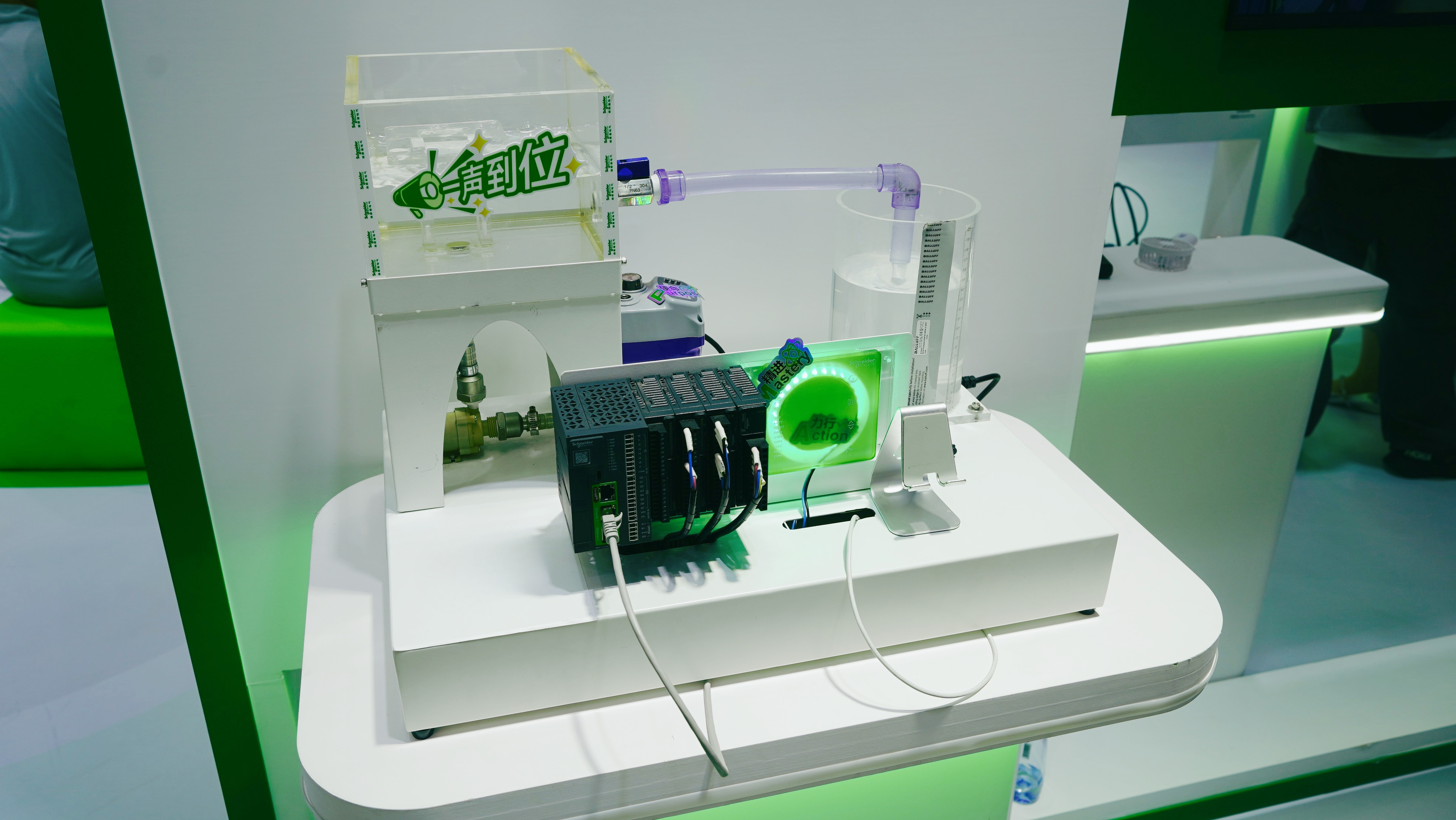
ALTEN China, as a core engineering service provider for a major electrical equipment manufacturer, has been deeply involved in the R&D of the client’s AI‑agent‑based liquid level control unit. Wang Yunhui, a system architecture engineer at ALTEN China, demonstrated the unit at WAIC. The system relies on a large‑language‑model agent to dynamically regulate tank liquid levels autonomously. Compared with conventional PLCs, it significantly improves adaptability in complex working conditions, directly addressing common pain points such as control oscillation and slow response.
Wang Yunhui is dedicated to translating laboratory AI algorithms into reliable productivity on the shop floor – moving intelligent control from proof‑of‑concept to value creation. As he puts it: “Making factory equipment understand human language is what truly reduces the burden on workers.”
Device Deep‑Dive: Liquid Level Control Without Manual Tuning
Q1: What is the core function and real‑world application scenario of the AI‑based liquid level control unit demonstrated at WAIC?
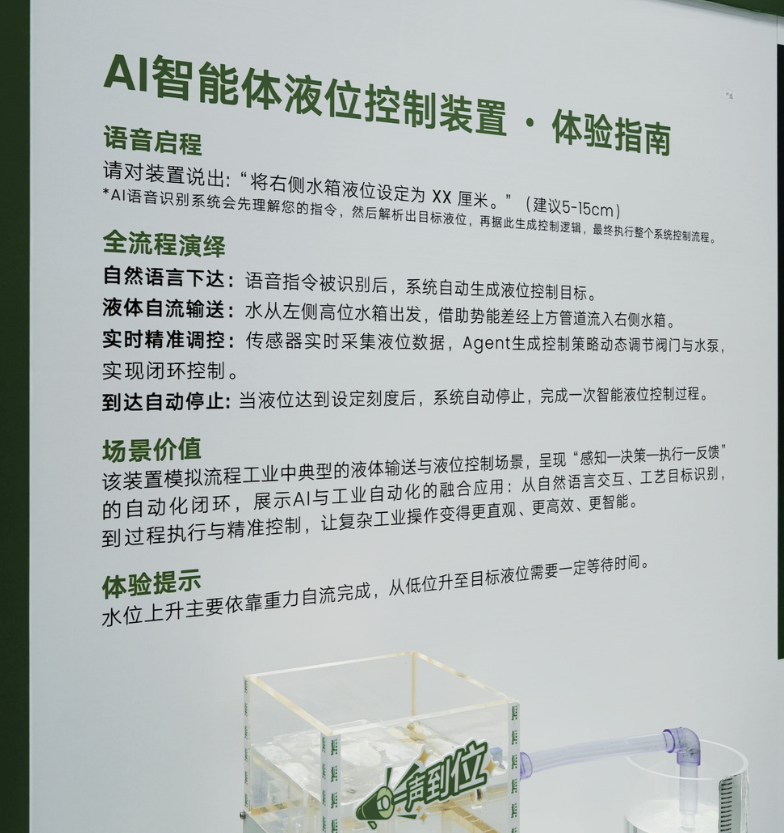
The control unit relies on a large‑model agent to autonomously regulate tank liquid levels in real time. It requires no preset PID parameters; instead, it continuously senses water level and inflow/outflow disturbances, reasons about control strategies on its own, and achieves smooth level stabilization while suppressing overshoot. Typical application scenarios include chemical buffer tanks, water‑treatment reservoirs, industrial circulating‑water systems, and energy‑storage tanks. The system is especially suited for flexible production environments with frequent process fluctuations and where accurate mathematical models are difficult to establish, effectively overcoming traditional issues of control oscillation and delayed response.
Q2: What is the most distinctive advantage of this AI agent solution compared with conventional liquid level control equipment?
Traditional PLC control relies heavily on manual parameter tuning. When operating conditions change, oscillation and overshoot often occur, and adaptability is poor. The AI agent solution distinguishes itself through autonomous perception, reasoning, and continuous self‑optimization. It also supports natural‑language interaction and autonomous anomaly detection, bridging the gap between device control and business logic to achieve intelligent control rather than mere logic execution.
Q3: Beyond this liquid level demonstration, what other, more complex AI industrial control agents are you and your team currently exploring?
In addition to the solution presented, our team is focusing on AI agents for servo motion control. These are designed for multi‑axis positioning, synchronous following, and flexible trajectory tracking – replacing traditional fixed‑parameter motion control algorithms. Our goal is to enable coordinated regulation of production‑line motion equipment and fluid systems, with targeted deployments in discrete manufacturing scenarios such as lithium‑battery production, packaging, and automated assembly.
On‑Site Observations: The Next Step for Industrial AI
Q1: WAIC brought together algorithm companies, hardware manufacturers, and end‑users. Did this diversity give you new insights into the general applicability of AI in engineering?
Industrial AI cannot be reduced to a competition over model parameters. Algorithm teams excel at modelling but often lack process knowledge; hardware vendors understand equipment but have limited intelligence‑orchestration capabilities; factories hold real‑world operating conditions but lack digital tools to leverage them. The general applicability of AI in engineering does not hinge on the large model itself, but on building a lightweight, embeddable, and industrial‑constraint‑aware deployment paradigm – one that bridges algorithms, hardware, and process expertise, and deeply integrates general models with domain‑specific knowledge.
Q2: In your view, what is the biggest collaboration gap in the current industrial AI ecosystem?
The biggest gap is the absence of a standardized bridge between process knowledge and AI technology. Industrial device protocols and data formats remain fragmented, and migrating models across scenarios incurs prohibitively high costs. There is a lack of common interaction standards and trusted evaluation benchmarks, and most players tend to develop in closed silos.
Q3: If you had to sum it up in one sentence to a non‑technical audience, how would you convey that “AI is not just a lofty concept – it is tangibly changing factories right now”?
AI is no longer just code in a lab – it is entering factories, reducing waste, stabilizing production, and making “intelligent manufacturing” a practical reality.
Engineers and AI: From Demo to Production‑Scale Methodology
Q1: As a full‑stack engineer working on back‑end, front‑end, and AI agents, how do you view the value of “full‑stack + AI” composite skills in industrial intelligence projects?
Industrial intelligence projects span hardware integration, back‑end data processing, front‑end visualization, and AI agent orchestration. A single‑discipline engineer often creates design gaps. With full‑stack plus AI capabilities, one can understand the complete chain – from on‑device data acquisition, through agent reasoning, to human‑machine interaction. This approach prevents AI solutions from becoming divorced from shop‑floor realities, accelerates end‑to‑end prototyping, aligns customer requirements efficiently, reduces cross‑functional communication overhead, and speeds the transition of industrial AI from demonstration to on‑site deployment.
Q2: What entry point would you recommend for traditional software engineers who wish to move into AI applications, and how should they stay technically relevant?
I recommend starting with application scenarios in specific industries and prioritizing AI engineering and deployment over deep‑diving into core algorithms. To stay relevant: follow advances in industrial agents and edge large models, but also spend time on the shop floor to acquire process awareness. Differentiate between academic research and engineering practice – focus on solving real business pain points and start with small‑scale AI applications that can quickly prove their value.
Q3: When an industrial AI solution moves from validation to mass production, what long‑term support measures should we as technical service providers put in place to ensure that “demo performance” translates into “production value”?
Moving to production requires more than prototype debugging. First, establish continuous on‑site data feedback loops to support ongoing agent optimization. Second, put in place model monitoring and anomaly alerting systems to safeguard production safety. Develop standardized operation and maintenance tools to lower on‑site support overhead. At the same time, provide ongoing training for operations staff and conduct regular process reviews. Most importantly, set up a quantitative value‑assessment framework – continuously tracking metrics such as energy consumption and yield – to iteratively refine the solution and ensure that the agent delivers sustained production benefits.
Closing Thoughts
From the WAIC 2026 exhibition floor to the complex conditions of real factories, industrial AI has moved beyond model demonstrations and conversational interfaces – it is now entering plants and solving genuine problems. Whether through autonomous liquid level optimization or intelligent servo motion coordination, AI agents are reshaping the fundamentals of Industry 4.0.
As a global technical services provider with deep roots in industrial engineering, ALTEN China is committed to bridging the gap between production reality and AI capabilities. We are working tirelessly to turn AI from isolated pilot projects into scalable, replicable solutions – driving the next wave of intelligent manufacturing.














 CN
CN